
3 Best Knitting Needles for Beginners: What to Buy First in 2026
As an Amazon Associate, this website earns from qualifying purchases.
The short answer
If you only buy one pair, get US 8 (5mm) bamboo straight needles with worsted weight yarn. Most beginner patterns are written for this exact combination.
Sections11
- #1. ChiaoGoo 9-inch Bamboo Straight Needles, US 8 (5mm): Best overall
- #2. Clover Takumi Combo Interchangeable Circular Needles: Best for trying sizes
- #3. Coopay Plastic Straight Knitting Needles (7 pairs): Best budget pick
- Factors to consider when choosing knitting needles for beginners
- Size Before Brand: Picking a Knitting Needle for Beginners
- Yarn Weight and Needle Size Chart (Craft Yarn Council Standard)
- Needle Material: Bamboo, Wood, Metal or Plastic
- Straight vs. Circular: Which Knitting Needle for Beginners
- More in this guide
- Beginner Knitting Needles FAQ
- Verdict on Choosing Beginner Knitting Needles
Our top 3 picks
- 1Best overall
 ChiaoGoo 9-inch Bamboo Straight Needles, US 8 (5mm)
- One pair of 9-inch single-point bamboo needles in US 8 (5mm)
- Needle size is laser etched on each needle
- Includes an aluminum stitch holder about 3.5 inches long
- 2Best for trying sizes
 Clover Takumi Combo Interchangeable Circular Needles
- 12 bamboo tip sizes from US 3 to US 15
- 5 cord lengths from 16 to 48 inches, for 60 combinations
- Fitted storage case for the tips and cords
- 3Best budget pick
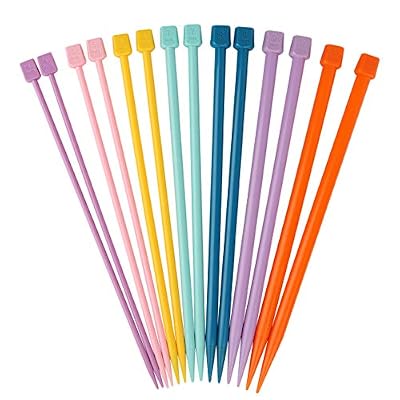 Coopay Plastic Straight Knitting Needles (7 pairs)
- 7 pairs of single-point needles from 4mm to 10mm
- Light ABS plastic in a different color for each pair
- Sizes cover worsted through bulky yarn
Choosing knitting needles for beginners is really two decisions, not one. The right knitting needle for beginners has the right size for your yarn, and a material that will not fight your hands. Get both right and almost any beginner pattern will work. Get them wrong and you will spend your first project wrestling with tools instead of learning the craft.
A beginner needs at most three purchases to start a first project. Choose by size and material, not by brand name. For more on interchangeable sets, see our Knit Pro needles guide.
#1. ChiaoGoo 9-inch Bamboo Straight Needles, US 8 (5mm): Best overall
ChiaoGoo 9-inch Bamboo Straight Needles, US 8 (5mm)
Our verdict:
Best overall
Best for a first project in worsted weight yarn, the size most beginner patterns call for.
View on Amazon- One pair of 9-inch single-point bamboo needles in US 8 (5mm)
- Needle size is laser etched on each needle
- Includes an aluminum stitch holder about 3.5 inches long
Keep in mind: It is one size only, and 9-inch needles are too short to hold a wide blanket.
Product details checked September 2026
A ChiaoGoo 9-inch bamboo straight pair in US 8 (5mm) covers the widest range of first patterns written for worsted weight yarn.
#2. Clover Takumi Combo Interchangeable Circular Needles: Best for trying sizes
Clover Takumi Combo Interchangeable Circular Needles
Our verdict:
Best for trying sizes
Best for a beginner who plans to keep knitting and wants to test several needle sizes on one cable system.
View on Amazon- 12 bamboo tip sizes from US 3 to US 15
- 5 cord lengths from 16 to 48 inches, for 60 combinations
- Fitted storage case for the tips and cords
- Made in Japan
Keep in mind: It is a bigger up-front purchase than a single pair, which is all a first scarf needs.
Product details checked September 2026
The Clover Takumi Combo bamboo interchangeable circular set lets you test several sizes on one cable instead of buying pair after pair.
#3. Coopay Plastic Straight Knitting Needles (7 pairs): Best budget pick
Coopay Plastic Straight Knitting Needles (7 pairs)
Our verdict:
Best budget pick
Best for trying a few needle sizes cheaply before paying for a nicer set.
View on Amazon- 7 pairs of single-point needles from 4mm to 10mm
- Light ABS plastic in a different color for each pair
- Sizes cover worsted through bulky yarn
Keep in mind: Plastic needles can feel less smooth than bamboo or metal, and the set skips the smaller sizes used for fine yarn.
Product details checked September 2026
The Coopay set of 14 plastic straight needles is a low-cost way to try a size before committing to a nicer set.
Factors to consider when choosing knitting needles for beginners
- Size first. A US 8 (5mm) needle matches worsted weight yarn, the weight most beginner patterns use. Buy the size your first pattern names.
- Material. Bamboo and wood grip the stitches, so they slide off less while your tension is still uneven. Metal is faster but slicker.
- Straight or circular. Straight needles are simple for flat pieces like scarves and dishcloths. Circulars also knit flat and let you move on to hats later.
- Length. A 9 to 10 inch straight needle is easy to handle for small projects. Longer needles hold more stitches for a blanket.
- Budget. A cheap plastic set lets you try sizes before you pay for a nicer pair.
Size Before Brand: Picking a Knitting Needle for Beginners
Size is set by your yarn, not the other way around. Every pattern names a yarn weight first. Your job is to match a needle size to that weight, then buy the needle that fits the job.
Most first patterns, like a simple scarf or dishcloth, call for worsted weight yarn. That weight pairs with a US 8 (5mm) needle. If you already own yarn, check its label for a suggested needle size before you buy anything. The label almost always tells you.
Brand matters far less than beginners expect. A US 8 bamboo needle from one maker behaves almost exactly like a US 8 bamboo needle from another. Spend your first purchase on getting the size and material right, not chasing a specific name.
It helps to think of the needle as a tool that matches the yarn, the way a screwdriver matches a screw. A thin sock yarn on a thick needle produces loose, gappy stitches. A bulky yarn on a thin needle fights you the whole way, because you cannot fit the loops onto the needle without stretching them. Reading your yarn label for its suggested needle size, then checking that size against the chart below, solves both problems before you cast on a single stitch.
Yarn Weight and Needle Size Chart (Craft Yarn Council Standard)
The Craft Yarn Council keeps the standard yarn weight system that almost every published pattern references, numbered from 0 (lace) to 7 (jumbo). Matching your needle to this chart removes the guesswork a beginner otherwise faces at the yarn shop. CYC's updated notice says the system now includes Size 8, Blocking and Plus Symbols. Source checked September 28, 2026.
| CYC weight | Common name | US needle | Metric needle | Stockinette gauge (stitches per 4 in) |
|---|---|---|---|---|
| 0 — Lace | Lace | 000–1 | 1.5–2.25 mm | 33–40 |
| 1 — Super Fine | Fingering, sock | 1–3 | 2.25–3.25 mm | 27–32 |
| 2 — Fine | Sport | 3–5 | 3.25–3.75 mm | 23–26 |
| 3 — Light | DK | 5–7 | 3.75–4.5 mm | 21–24 |
| 4 — Medium | Worsted, aran | 7–9 | 4.5–5.5 mm | 16–20 |
| 5 — Bulky | Chunky | 9–11 | 5.5–8 mm | 12–15 |
| 6 — Super Bulky | Super chunky | 11–17 | 8–12.75 mm | 7–11 |
| 7 — Jumbo | Jumbo | 17 and up | 12.75 mm and up | 6 or fewer |
Scroll for more →
Treat the gauge column as a starting point, not a promise. Everyone knits a little tighter or looser than the chart. Knit a small swatch before you start a real project so you can check your own tension against the pattern.
Where guideline ranges overlap
Comparing adjacent CYC gauge intervals as inclusive ranges, Fine (23–26) and Light (21–24) share 23–24 stitches per 4 inches. At 24 stitches per 4 inches, both categories fit; their shared recommended needle endpoint is 3.75 mm (US 5). Other adjacent gauge ranges do not overlap. This analysis describes published guidelines, not measured knitter outcomes. Fiber, tension and pattern gauge matter; follow the pattern and swatch with your yarn.
For more yarn guidance, see DK yarn weight, aran weight yarn and wool weights. The complete source and overlap method are available on the clean needle/yarn reference, alongside its gauge calculator.
Source: Craft Yarn Council's www.YarnStandards.com. Recheck this source quarterly and when its chart changes.
Needle Material: Bamboo, Wood, Metal or Plastic
Material changes how easily a stitch slides along the needle. It does not make one needle better than another in any absolute sense; it changes what feels right in your hands.
Bamboo and wood grip the yarn lightly. That grip slows stitches down while you are still building even tension, which is exactly what a first-time knitter needs. They are also warm to hold and quiet to work with, which some beginners find calming.
Metal needles are fast and smooth. Stitches glide, which experienced knitters like once their tension is consistent. For a beginner, that same speed often means stitches slip off the tip before you meant to move them.
Plastic needles are the cheapest way to try a size before committing to a nicer pair. They flex more than bamboo or metal, which some beginners like for wrist comfort during a long session.
Pick bamboo or wood for your very first project. Once your hands know what even tension feels like, try metal and see whether the extra speed suits you.
Straight vs. Circular: Which Knitting Needle for Beginners
This choice is about the shape of your project, not your skill level. Circular needles work fine for flat knitting; the cable between the two tips just sits unused while you knit back and forth.
Straight needles are the simplest way to learn a flat project like a scarf or dishcloth. Two needles, one stitch pattern, nothing else to think about.
Circular needles matter once you are knitting in the round, such as a hat, or when you want one cable length to cover several needle sizes through an interchangeable set. Their join also stops a stitch from sliding off an exposed needle tip if you set your work down mid-row.
Neither choice is more advanced than the other. Choose the one that matches the first project you actually want to make.
Some beginners worry that circular needles are "for experts." They are not. A circular needle used flat, knitting one row and turning the work at the end, behaves exactly like a pair of straight needles. The only real difference shows up once you learn to knit in a continuous round without turning, which is a separate skill you can pick up later.
More in this guide
Beginner Knitting Needles FAQ
What needle size is easiest for beginners?
US 7-9 (4.5-5.5mm) with a worsted weight yarn is the easiest combination to see and control while you are learning. Thinner needles make stitches small and fiddly. Much thicker needles make it hard to keep your tension even from stitch to stitch.
Do I need circular needles to start?
No. Straight needles are simpler to learn on for a flat project like a scarf or dishcloth. Circular needles matter once you are knitting in the round, such as a hat, or want one cable to cover several sizes.
Bamboo or metal: which is better for a first project?
Bamboo and other wood needles grip the yarn, which slows stitches from sliding off while you build consistent tension. Metal needles are faster once you are confident, but they can feel slippery during your very first project.
What yarn weight should a beginner start with?
Worsted weight (Craft Yarn Council Medium, category 4) is the most common starting point. It knits up quickly, shows stitches clearly while you learn, and matches the widest range of free beginner patterns.
How many needles does a beginner actually need?
One pair, sized to your first yarn, is enough to finish a first project. Add a second size only once you pick a project that calls for it, rather than buying a full set up front.
Verdict on Choosing Beginner Knitting Needles
Choosing the right knitting needle for beginners comes down to two small choices: size, matched to your yarn's weight on the Craft Yarn Council chart, and material, chosen for grip over speed. A US 8 (5mm) bamboo straight pair with worsted weight yarn covers the widest range of first patterns and is the safest place to start. Everything else, including brand, interchangeable sets, and circular cables, can wait until your first project is off the needles.
Our picks in this topic
3 picks
3 Best Linen Yarns for Beginners and How to Knit Them in 2026
Why linen yarn feels different from wool, which weight and needle size to start with, and how to pick a beginner-friendly linen blend.