
3 Best Yarn Winders: Types, Uses and How to Choose in 2026
As an Amazon Associate, this website earns from qualifying purchases.
The short answer
A hand-crank ball winder paired with a swift suits most knitters; go electric or jumbo only if you wind a lot.
Sections10
- #1. Knit Picks Yarn Ball Winder: Best overall
- #2. Stanwood Needlecraft Wooden Umbrella Swift (Medium): Best pairing
- #3. Caydo Electric Yarn Winder M1: Best electric option
- Factors to consider when choosing a yarn winder
- What a Yarn Winder Does
- Yarn Winder Types
- Do You Need a Swift Too
- How to Use a Yarn Winder
- Yarn Winder FAQ
- Verdict on Choosing a Yarn Winder
Our top 3 picks
- 1Best overall
 Knit Picks Yarn Ball Winder
- Winds up to 100 grams (3.5 oz) into a center-pull cake
- Clamps to a table edge up to 1-1/2 inches thick
- Removable spindle and folding guide arm for storage
- 2Best pairing
 Stanwood Needlecraft Wooden Umbrella Swift (Medium)
- Finished birch umbrella swift that spins smoothly
- Holds skeins up to about 6 feet around
- Folds closed for storage
- 3Best electric option
 Caydo Electric Yarn Winder M1
- Motorized winding with adjustable speed
- Makes cakes up to about 7 oz
- Spring tension helps keep cakes firm
A yarn winder turns a loose hank or a messy skein into a neat, tidy ball you can knit from. If you buy yarn from independent dyers or yarn shops, a lot of it comes as a twisted hank. You cannot knit straight from a hank without it tangling, so a winder quickly earns its place.
#1. Knit Picks Yarn Ball Winder: Best overall
Our verdict:
Best overall
Best for winding single skeins of most yarn weights at home.
View on Amazon- Winds up to 100 grams (3.5 oz) into a center-pull cake
- Clamps to a table edge up to 1-1/2 inches thick
- Removable spindle and folding guide arm for storage
Keep in mind: A 100 g limit means big blanket skeins need a jumbo winder.
Product details checked September 2026
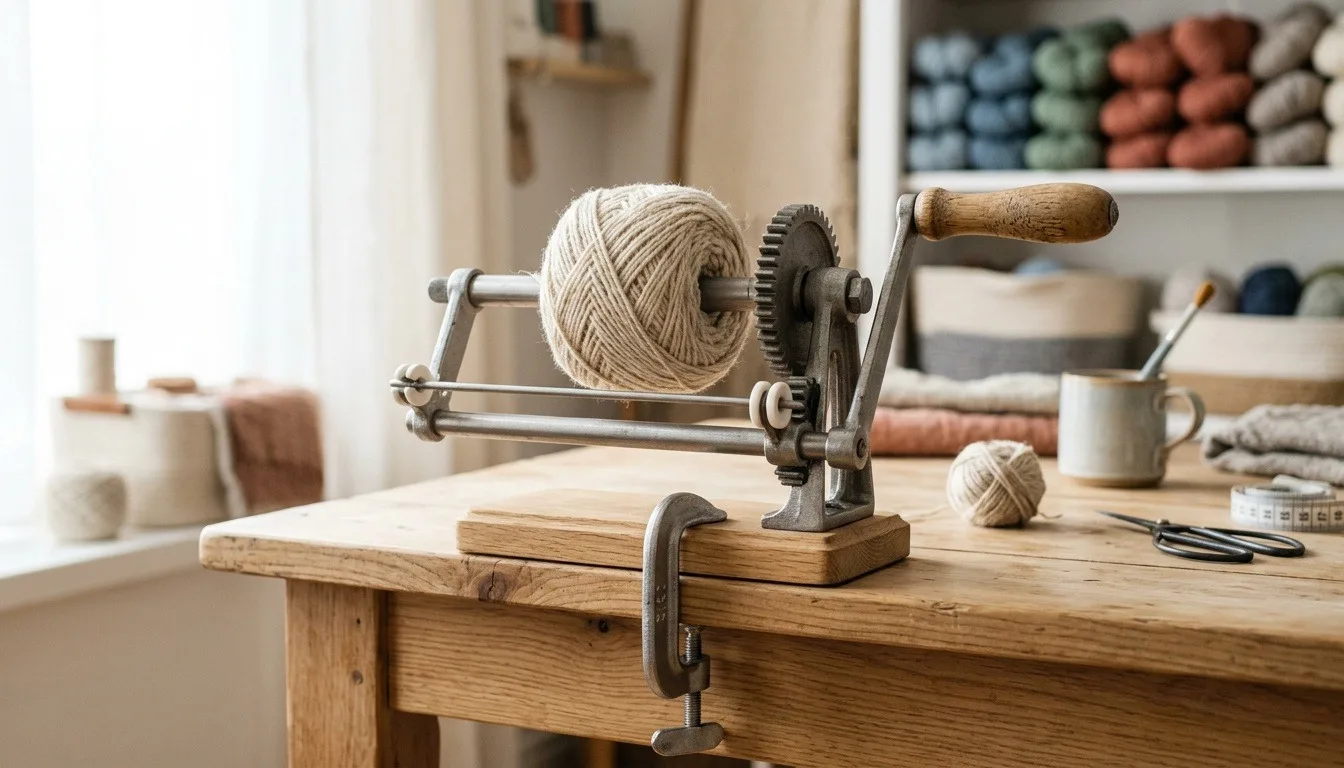
The Knit Picks Yarn Ball Winder, a hand-crank winder, handles single skeins of most yarn weights.
#2. Stanwood Needlecraft Wooden Umbrella Swift (Medium): Best pairing
Stanwood Needlecraft Wooden Umbrella Swift (Medium)
Our verdict:
Best pairing
Best for holding a hank steady while you wind it with a ball winder.
View on Amazon- Finished birch umbrella swift that spins smoothly
- Holds skeins up to about 6 feet around
- Folds closed for storage
Keep in mind: It clamps to a table, so you need an edge it can grip.
Product details checked September 2026
The Stanwood Needlecraft wooden umbrella swift holds hanks steady while you wind.
#3. Caydo Electric Yarn Winder M1: Best electric option
Our verdict:
Best electric option
Best for knitters who wind single skeins often and want to spare their wrists.
View on Amazon- Motorized winding with adjustable speed
- Makes cakes up to about 7 oz
- Spring tension helps keep cakes firm
Keep in mind: It needs power, and a 7 oz limit is too small for jumbo blanket skeins.
Product details checked September 2026
The Caydo M1 does the cranking for you, with adjustable speed and cakes up to about 7 oz. It suits anyone whose wrists tire on a hand crank.
Factors to consider when choosing a yarn winder
Start with how much you wind and how big your skeins are.
- Capacity: check the largest cake the winder can make. A standard winder is fine for most single skeins. Big blanket skeins need a jumbo model.
- Clamp: look at how wide the table clamp opens. A clamp that does not fit your table edge makes the winder useless.
- Gears: a covered gear box keeps yarn and fluff out of the moving parts, so it jams less.
- Material: plastic winders are light and cheap. Metal and hardwood winders are heavier and steadier at speed.
- Power: electric winders need a plug, USB power or batteries. Check which before you buy.
What a Yarn Winder Does
A winder wraps yarn around a spinning core at an angle. The result is a flat-topped, flat-bottomed "yarn cake" that sits still on the table. The yarn feeds from the center, so the cake does not roll around while you knit.
That center-pull feed is the main reason to own one. A hand-wound ball rolls away and picks up fluff. A yarn cake stays put and pays out yarn evenly.
A winder also helps in a few other ways:
- Checking the yarn: you see knots or weak spots as they pass through your fingers.
- Splitting a skein: you can wind half, cut, and wind the rest into a second cake for two-at-a-time socks or sleeves.
- Holding yarn double: you can wind two strands together into one cake.
- Reclaiming yarn: you can rewind yarn you have ripped out of an old project.
Yarn Winder Types
Hand-crank ball winders are the most common kind. You clamp one to a table and turn a handle. Most hold about 100 grams, or 3.5 to 4 ounces, per cake. That covers a single skein of most yarn. Our yarn ball winder guide goes deeper on these.
Jumbo ball winders work the same way but make bigger cakes. Some are built for skeins of 7 ounces or more, and large hardwood models go past a pound. They suit blanket yarn and big hand-dyed skeins.
Electric yarn winders spin the core with a small motor. You guide the yarn while the machine does the turning. They save wrist strain if you wind a lot. See our electric yarn winder guide for the tradeoffs.
Skein winders do the opposite job. They wind yarn from a cone or a ball back into a hank. Dyers and spinners use them. Most knitters never need one.
Nostepinnes are simple wooden sticks. You wrap yarn around the stick by hand to make a center-pull ball. They are cheap and quiet, but slower than a crank. Our manual yarn winder guide compares hand options.
Do You Need a Swift Too
A swift is a spinning frame that holds a hank open while you wind it. It keeps the hank turning smoothly, so the yarn does not tangle as the winder pulls it.
You can wind a hank without one. A helper can hold the hank on their outstretched arms, or you can loop it around the backs of two chairs. Both work, but they are slow and tangle more easily.
If you buy hanks often, a swift makes winding much faster. Read our wool swift guide for the umbrella and Amish styles.
How to Use a Yarn Winder
- Clamp the winder to the edge of a table. Clamp the swift a few feet away.
- Untwist the hank and open it into a loop. Place it over the swift and tighten the swift until the loop is snug.
- Find the outer yarn end and cut or untie any ties holding the hank together.
- Thread the end through the winder's guide and tuck it into the slot on top of the core.
- Turn the handle slowly at first. Keep light, even tension on the yarn with your free hand.
- When the hank is used up, slide the cake off the core. The end tucked in the slot is your center-pull end.
Wind at a steady pace, not a fast one. Winding too tight stretches the yarn. A stretched yarn can relax later and change your gauge.
Yarn Winder FAQ
What is a yarn winder used for?
It turns hanks and skeins into flat, center-pull yarn cakes. The cake sits still and feeds yarn smoothly from the middle while you knit.
Is a winder worth it?
Yes, if you buy yarn in hanks. Hand winding a hank into a ball is slow and tangles easily. If all your yarn comes in ready-to-use balls, you may not need one.
How much yarn does a winder hold?
Most standard hand-crank models hold about 100 grams, or 3.5 to 4 ounces. Jumbo models hold more. Check the listed capacity before you buy.
Can I use a winder without a swift?
Yes. Loop the hank over a helper's hands or the backs of two chairs. A swift is faster and tangles less.
Verdict on Choosing a Yarn Winder
A hand-crank ball winder paired with a swift is the right yarn winder for most knitters. It turns any hank into a tidy center-pull cake in a few minutes. Choose a jumbo model if you knit big blankets from large skeins, and an electric model if you wind often enough that cranking starts to hurt.