
3 Best Yarn Needles for Weaving In Ends and Seaming in 2026
As an Amazon Associate, this website earns from qualifying purchases.
The short answer
A blunt-tip yarn needle with an eye sized to your yarn weight covers almost every finishing job.
Sections10
- #1. TLKKUE Large-Eye Blunt Yarn Needles (12 pieces, 3 sizes): Best overall
- #2. Clover Chibi Bent Tip Tapestry Needle Set: Best for seaming
- #3. Clover Super Jumbo Tapestry Needles (set of 2): Best for chunky yarn
- Factors to consider when choosing a yarn needle
- What a Yarn Needle Actually Is
- Yarn Needle Types: Blunt, Sharp and Bent Tip
- Threading a Yarn Needle and Weaving In Ends
- How to Weave In Ends
- Yarn Needle FAQ
- Verdict on Choosing a Yarn Needle
Our top 3 picks
- 1Best overall
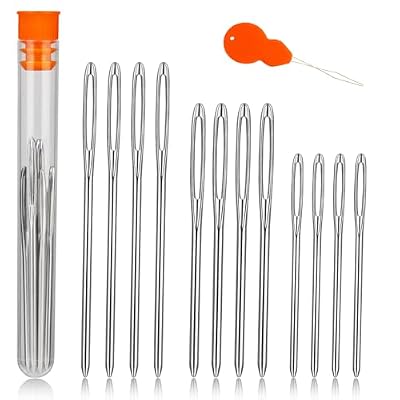 TLKKUE Large-Eye Blunt Yarn Needles (12 pieces, 3 sizes)
- 12 steel blunt needles in 3 lengths, about 2 to 2.75 inches
- Large eyes for threading yarn
- Blunt tips slide between stitches without splitting fibers
- 2Best for seaming
 Clover Chibi Bent Tip Tapestry Needle Set
- 3 bent-tip tapestry needles (two No. 12 and one No. 15)
- Comes in a small needle-shaped case
- 3Best for chunky yarn
 Clover Super Jumbo Tapestry Needles (set of 2)
- 2 jumbo tapestry needles with blunt tips
- Large eyes for thick yarn
- Curved tips
A yarn needle is a large-eye needle you use to weave in yarn ends and sew knitted or crocheted pieces together. It plays no part in making the stitches. Even so, almost every finished project needs one before it is truly done.
Pick a set by the yarn weights you use most, not by one all-purpose size.
#1. TLKKUE Large-Eye Blunt Yarn Needles (12 pieces, 3 sizes): Best overall
TLKKUE Large-Eye Blunt Yarn Needles (12 pieces, 3 sizes)
Our verdict:
Best overall
Best for weaving in ends on fingering through bulky yarn.
View on Amazon- 12 steel blunt needles in 3 lengths, about 2 to 2.75 inches
- Large eyes for threading yarn
- Blunt tips slide between stitches without splitting fibers
Keep in mind: Straight tips are harder than bent tips for picking up edge stitches when seaming.
Product details checked September 2026
A TLKKUE set of 12 large-eye blunt needles in 3 sizes covers fingering through bulky yarn.
#2. Clover Chibi Bent Tip Tapestry Needle Set: Best for seaming
Clover Chibi Bent Tip Tapestry Needle Set
Our verdict:
Best for seaming
Best for seaming and picking up edge stitches.
View on Amazon- 3 bent-tip tapestry needles (two No. 12 and one No. 15)
- Comes in a small needle-shaped case
Keep in mind: Only three needles, and the eyes are too small for super bulky yarn.
Product details checked September 2026
The Clover Chibi bent-tip tapestry needle set makes it easier to pick up edge stitches.
#3. Clover Super Jumbo Tapestry Needles (set of 2): Best for chunky yarn
Clover Super Jumbo Tapestry Needles (set of 2)
Our verdict:
Best for chunky yarn
Best for weaving in ends and seaming with bulky and super bulky yarn.
View on Amazon- 2 jumbo tapestry needles with blunt tips
- Large eyes for thick yarn
- Curved tips
Keep in mind: Too big for fingering or DK seams, where a smaller needle slides through the stitches more easily.
Product details checked September 2026
Clover's super jumbo pair has large eyes and blunt, curved tips for weaving in bulky and super bulky ends. If your needles tend to go missing, store them in a small tin or in the pocket of your needle case.
Factors to consider when choosing a yarn needle
The eye should fit your yarn without a struggle. If you have to force the yarn through, the eye is too small, and the strand will fray as you pull it back and forth. If the eye is far bigger than the yarn, the needle can stretch the stitches and leave small holes, which shows most in fine yarn.
A simple way to think about it uses the Craft Yarn Council weight system:
- Lace to fingering weight: a small needle with a narrow eye.
- Sport to worsted weight: a medium needle. This is the size most beginners use first.
- Bulky and super bulky: a large needle with a long eye, or a latch-style needle made for thick yarn.
Length helps a little too. A longer needle covers more stitches per pass when you weave an end along a long seam.
What a Yarn Needle Actually Is
It is not sharp like a sewing needle. Its tip is rounded. That lets it pass between the strands of a stitch instead of piercing the yarn itself.
You will see it sold under a few names. Tapestry needle and darning needle usually mean the same kind of large-eye, blunt needle. Some brands use darning needle for a slightly longer version, but the job is the same.
You reach for one at two points in a project. The first is weaving in the loose tails left from casting on, binding off and joining new yarn. The second is seaming, when you sew two pieces together along an edge, like the sides of a sweater or the top of a hat.
The eye is the other big difference from a sewing needle. It is long and wide enough to take a full strand of yarn. A sewing needle's eye is sized for thread.
Yarn Needle Types: Blunt, Sharp and Bent Tip
Blunt tip needles are the standard pick for knitting and crochet. The rounded point slides between stitches. Your seams and woven ends stay clean, and the yarn does not fray.
Sharp tip needles have a fine point. They suit jobs where you must go through fabric, not between stitches. Examples are sewing a knitted patch onto woven cloth or stitching through felted wool. Most everyday knitting never needs one.
Bent tip needles have a small upward curve near the point. The curve makes it easier to scoop up a stitch on the edge of a piece, which helps when you seam. Many knitters like one for mattress stitch on sweater sides.
Material matters less than tip shape. Metal needles are slim and smooth, and they last for years. Plastic needles are light and cheap, and the bright colors are easy to find in a project bag. Plastic can bend or snap if you force it through a tight seam, though.
Threading a Yarn Needle and Weaving In Ends
Yarn is thicker and fuzzier than sewing thread, so pushing a cut end straight through the eye often fails. Most knitters fold the end over the needle and push the flat fold through the eye instead. For very fuzzy or bulky yarn, a small wire needle threader helps.
Weaving in ends means running each loose tail through the backs of stitches on the wrong side, so it stays put and does not show. Leave a tail long enough to thread comfortably when you cut the yarn, and do not trim it flush.
For clear photos of both steps, follow a dedicated tutorial such as The Spruce Crafts' beginner's guide to tapestry needles. The same needle and the same method work for knitting and crochet.
How to Weave In Ends
Leave a tail of about 6 inches whenever you cut yarn. That gives you enough length to thread the needle and weave with room to spare.
Thread the tail onto your needle. Work it through the backs of the stitches on the wrong side of the piece for a few inches. Then change direction and weave back a short way. The change of direction locks the end so it does not work loose with wear.
Stretch the fabric gently before you trim the tail. Cut close to the fabric, but not flush, so the end does not pop back out.
Yarn Needle FAQ
What is a yarn needle used for?
Weaving in loose ends and sewing knitted or crocheted pieces together. It is a finishing tool, not a tool for making stitches.
Is a yarn needle the same as a tapestry needle?
Yes, in most shops the two names mean the same large-eye, blunt needle. Darning needle is often used for the same tool too, sometimes for a longer version.
Should it be sharp or blunt?
Blunt, for almost all knitting and crochet. A blunt tip slides between stitches instead of splitting the yarn. Sharp tips are for sewing through woven or felted fabric.
What size do I need?
One whose eye takes your yarn without forcing it. Fine yarn needs a smaller eye, and bulky yarn needs a large one, so a mixed set is the easy choice.
Can I use a sewing needle instead?
Not really. A sewing needle's eye is too small for most yarn, and its sharp tip splits the strands as you weave.
Verdict on Choosing a Yarn Needle
A blunt-tip yarn needle with an eye sized to your yarn weight covers almost every finishing job a knitting or crochet project needs. Buy a small set of mixed sizes if you work with more than one weight. Add a bent-tip needle if seaming feels awkward. It is a small tool, but the right yarn needle is what makes a finished piece look finished.